Clinical Knowledge. Shared.
Clinical knowledge that moves practice forward.
Access relevant cases, guideline digests, evidence infographics and practice updates — curated for healthcare professionals and strengthened by peer contribution.
The Platform
A trusted space where doctors learn, contribute and advance clinical practice.
MedScribe is a peer-led medical knowledge platform. Not another news portal, and not a repository of sponsored articles — a working library built with doctors, for doctors, where evidence and experience meet.
Every piece of content is organised by specialty, condition and format; labelled by provenance; and reviewed under a published editorial policy. Contribution is professional currency here — not popularity.
Knowledge Platform
Reliable, clinically relevant information organised by specialty, condition and content type — findable in seconds.
Clinical Learning Platform
Cases, polls and quizzes with answers and rationale turn passive reading into active learning.
Contribution Platform
Verified doctors publish clinical cases, guideline digests and clinical polls — with attribution.
Collaboration Platform
Compliant, clearly disclosed opportunities for societies, hospitals, academic institutions and industry to support education.
How Verification Works
Verified doctors only, so you know who wrote what you read.
Create your account
Your name, email and a password. Confirm your email with the 6-digit code we send you.
Add your registration
Your medical registration number and council, qualification and specialty. You can attach your registration certificate; it is stored privately.
We check it
Our team checks your details with the medical council. This usually takes a few working days, and we email you the moment it is decided.
Full access
Read complete cases and guideline digests in full, and contribute cases, guideline digests and polls under your own name.
Before verification, and as a visitor, you can read titles and short previews of cases and guideline digests. Registration is free.
Select Your Specialty
17 specialties, each a knowledge hub of its own.
Cardiology
→02Critical Care
→03Dermatology
→04Diabetes & Endocrinology
→05Emergency Medicine
→06Gastroenterology
→07General Medicine
→08Infectious Diseases
→09Nephrology
→10Neurology
→11Obstetrics & Gynaecology
→12Oncology
→13Ophthalmology
→14Orthopaedics
→15Paediatrics
→16Respiratory Medicine
→17Rheumatology
→AllBrowse all specialties
Coming soon — Psychiatry · ENT · Urology
Latest Clinical Case
GnRH Antagonist Therapy in Moderate-to-Severe Endometriosis: Clinical Efficacy of Elagolix
Patient
32-year-old · Female
Chief complaint
Full clinical details uploaded in attached case documents.
History
Attached clinical case documents submitted for editorial review.
Presentation
A 32-year-old nulliparous woman (BMI: 24.1 kg/m²) presented with a 7-year history of progressive dysmenorrhea, chronic pelvic pain, and dyspareunia after the failure of multiple hormonal therapies. Physical examination revealed bilateral…
Work through the case.
The full case has the work-up, the clinical questions and the discussion. Verified doctors can answer and see how their peers responded.
Read the case→Guideline Update
What changed in the latest guideline?
Guidelines are lengthy, scattered and difficult to apply quickly. MedScribe distils each major update into what changed, why it matters, and what it means for your next clinic — with the original source one tap away.
No guideline digests published yet
Evidence in a Glance
Clinical cases and practice-changing evidence, drawn as infographics.
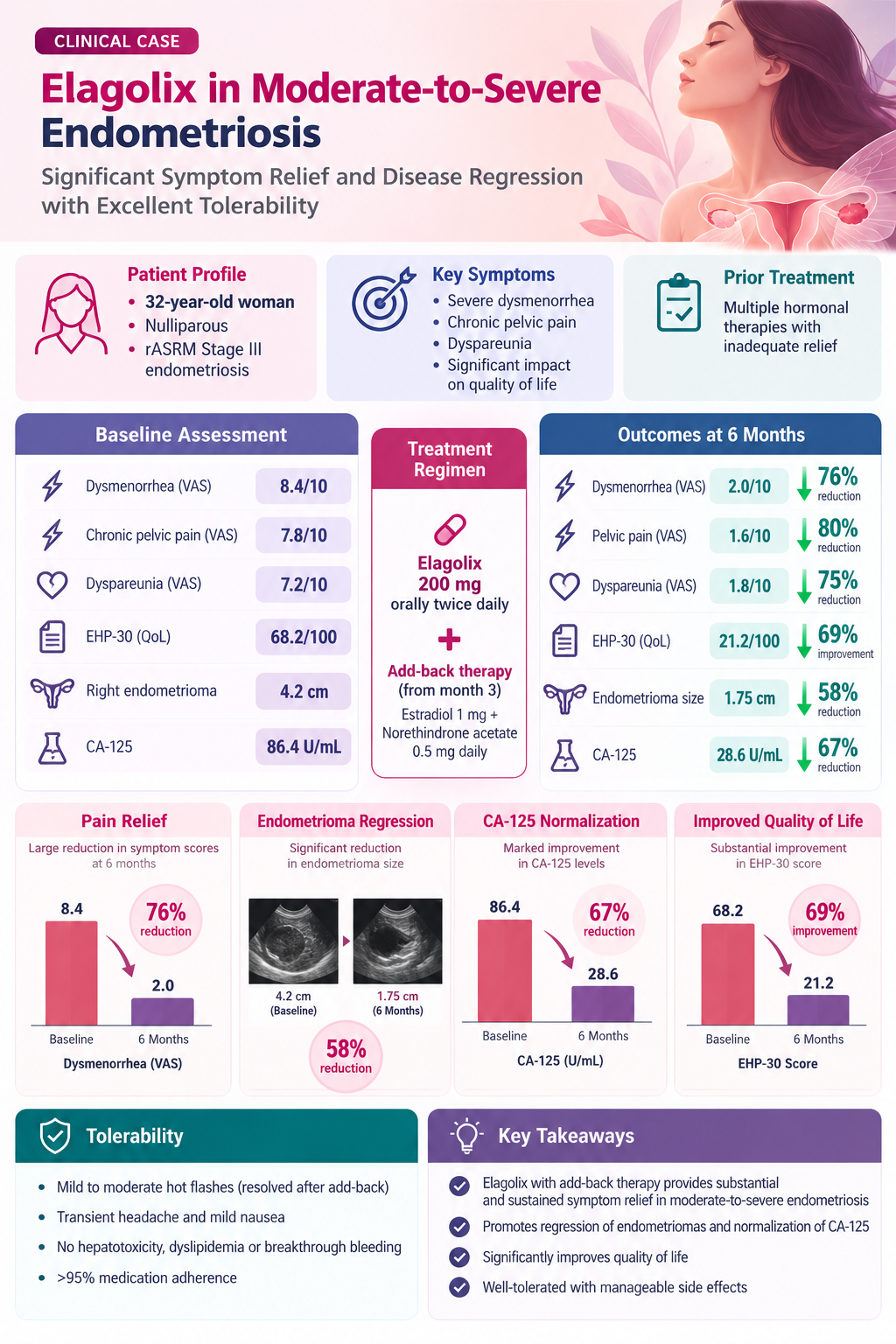
Infographic · Obstetrics & Gynaecology
GnRH Antagonist Therapy in Moderate-to-Severe Endometriosis: Clinical Efficacy of Elagolix
32-year-old woman · Stage III endometriosis with severe dysmenorrhea · Elagolix 200mg twice daily with add-back therapy · 80% pelvic pain reduction at 6 months
Full infographic →Medical News — With Context
Not just what happened. Why it matters, and to whom.
DCGI plans nationwide cough syrup plant inspections
Why it matters: Contaminated syrups have caused paediatric deaths in India.
UN adopts pandemic preparedness declaration
Why it matters: The declaration sets the political direction for surveillance, financing, equitable access and local manufacturing that will shape preparedness systems, including in India.
Learning Opportunities
Structured learning, evidence-led and case-based.
Case-Based Learning
Stepwise cases: presentation, work-up, the clinical question and the discussion.
ii.Guideline Digests
What changed in each update, why it matters, and a link to the original source.
iii.Evidence Infographics
Clinical cases and practice-changing evidence, drawn on a single page.
iv.Webinars
Live and on-demand sessions, listed in your feed.
Contribute to MedScribe
Your experience can strengthen someone else’s practice.
Verified doctors publish with attribution, and each published case has a public page they can share. Every submission is checked by the editorial team before it goes live, and case authors confirm patient consent and anonymisation when they submit.
How it works — choose a type → submit → editorial review (three stages) → published with your name.
Coming soon
Editorial Governance
Every piece passes three stages before it reaches you.
Intake & Source Check
Each submission — from a verified doctor, our editors or an AI draft — is checked for completeness, patient anonymisation and the sources it relies on.
Editorial Team
Clinical & Evidence Review
A medical editor checks clinical accuracy against the cited evidence. AI drafts arrive with the sources they were written from, and the editor checks them before approving.
Medical Editor · AI-assisted checks
Compliance & Sign-off
Disclosures and sponsorship labels are confirmed, then the content is approved and published — or scheduled for publication — by a named editor.
Editorial Lead
AI assists the review — it never publishes. Every AI draft is checked and approved by a person before it goes live, and authors are told the outcome of every decision on their submission.
Societies & Institutions
Co-branded hubs that extend your educational reach.
Societies, hospitals and academic departments receive dedicated hubs — guidelines, consensus documents, meeting highlights, member resources and events — within MedScribe’s consistent editorial frame.
Guideline library
The society’s guidelines and consensus documents, summarised in MedScribe’s digest format
Meeting highlights
Key sessions and takeaways from annual meetings and conferences
Member resources
Practice protocols, case programmes and announcements for members
Events and webinars
Recorded sessions and upcoming events, listed alongside the hub
MedScribe by Medwiz Global
Two decades of evidence-led medical education stand behind this platform.
Medwiz Global has worked across therapy areas and borders since 2005 — with an evidence-first, compliant approach to medical communication. MedScribe is its long-term, owned digital home for clinical learning.
2005
Working since
10,000+
Projects delivered
20+
Therapy areas
10,000+
Experts engaged
100,000+
HCP engagements
Questions
Frequently asked questions
Who can join MedScribe?
Is MedScribe free?
How long does verification take?
What can I see before I'm verified?
How is content checked?
Does MedScribe use AI?
Do I get CME or CPD credit?
Can I contribute?
How is my data protected?
Stay Informed
New cases and guideline updates, by email.
Occasional emails when new clinical cases, guideline digests and platform news are published. Unsubscribe any time.
We'll email you a link to confirm. See how we use your email.
Join the Community
Read. Reflect. Contribute.
Registration takes under two minutes. Verification unlocks full cases and guideline digests, contribution and your personalised specialty feed.